

Contact Us
Please contact us using the form below. We will get back to you as quickly as possible. You can also email us at info@bjitgroup.com.

By 2025, enterprise adoption of AI had become widespread, yet many organizations remained in early “pilot purgatory”—running isolated experiments without scaled business impact. According to McKinsey’s State of AI 2025 Report, 88% of organizations use AI in at least one function, but only a small fraction have industrialized it across the enterprise. Most deployments remain fragmented, lacking governance frameworks and workflow integration that deliver measurable value beyond initial experimentation.
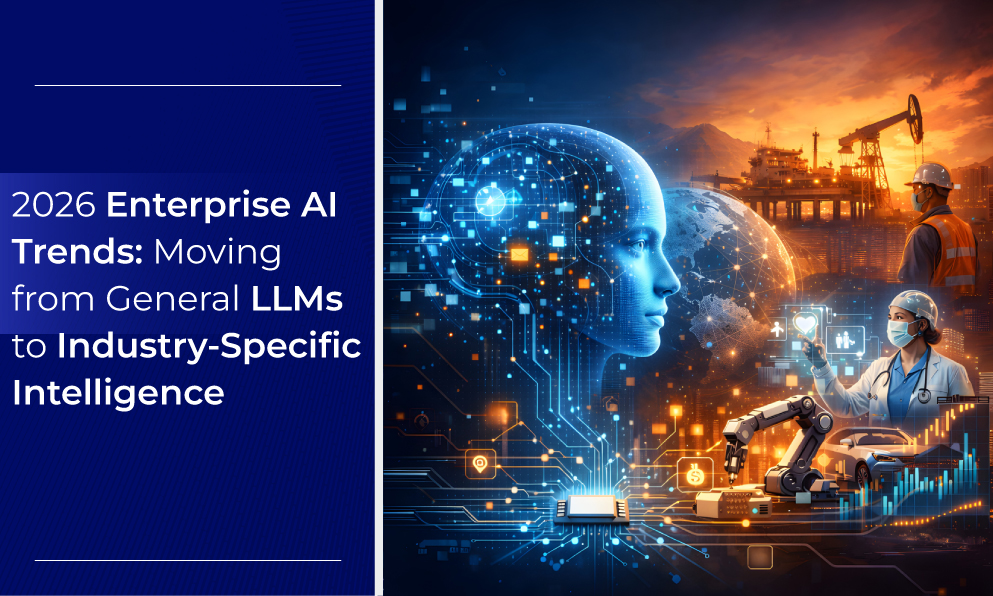
Enterprise leaders increasingly recognize that general-purpose Large Language Models (LLMs) —while useful for early adoption —are insufficient to drive robust business transformation at scale. This realization is fueling a strategic shift toward Vertical AI: domain‑specific, integrated, and governance‑aligned intelligence tailored to industry contexts.
BJIT’s enterprise AI engagements reinforce this trend. Organizations typically start with broad LLM experiments, then pivot toward purpose‑built, industry‑aligned AI systems that integrate deeply with ERP, CRM, and operational systems —moving from tactical productivity to strategic differentiation.
Explore how BJIT can help your organization transition from general-purpose AI to Vertical AI for measurable ROI and operational excellence.
Enterprise AI adoption has climbed rapidly. Recent industry analyses show a significant surge in AI deployments, with many organizations transitioning from conceptual experimentation to initial production use cases. However, this broader adoption contrasts sharply with limited strategic impact. McKinsey’s data reveals that even with 88% adoption, only around 6% of companies report meaningful transformation in EBIT attributable to AI.
This differentiation — between adoption and value realization — underscores a central strategic trend: AI only drives enterprise value when it’s embedded into core business processes with governance, domain context, and measurable outcomes.
One of the most prominent 2026 AI trends is the uptake of agentic AI — systems capable of autonomous planning and multi‑step execution, as opposed to reactive text generation. Industry forecasts predict widespread enterprise agent adoption, with embedded AI copilots projected to appear in the majority of business applications by 2026.
This shift toward intelligent agency is a natural precursor to Vertical AI, as true operational autonomy requires domain‑specific rules, compliance controls, and tight integration with enterprise systems — capabilities that generic models alone cannot deliver.
Despite rapid adoption, many enterprises struggle to convert AI into measurable business outcomes. A 2025 Boston Consulting Group (BCG) analysis reports that only about 5% of companies are significantly benefiting from AI investments, citing lack of governance, strategy, and cross‑functional ownership as key barriers.
This gap between experimentation and impact is rooted in three structural challenges:
BJIT’s experience shows that these barriers are best addressed through structured AI platforms that integrate deeply with enterprise data and operational workflows, rather than standalone LLM interfaces.
Connect with BJIT’s AI experts to design agentic AI solutions tailored for your industry and operational needs.
A general Large Language Model (LLM) is a machine learning model trained on diverse, broad‑domain text data to generate or understand human language across many topics. While versatile, general LLMs lack deep industry‑specific context, embedded business logic, and compliance‑aware reasoning required for reliable enterprise use.
Although general LLMs offer flexibility across multiple domains, they tend to be shallow in domain understanding. Enterprises in manufacturing, finance, healthcare, and supply chain industries require models that understand intricate business rules, compliance constraints, and industry terminology — aspects generic models were not designed to address.
For example:
BJIT’s approach focuses on domain tuning and architectural integration, ensuring models operate within enterprise governance boundaries.
Another material limitation of general LLMs is cost. As model usage scales across enterprise functions, inference — the process of generating outputs — becomes a dominant driver of computing costs. Recent trend analyses indicate that inference will account for two‑thirds of AI computing power by 2026, compelling enterprises to rethink model selection and deployment architectures.
By contrast, domain‑optimized models can be lighter, cheaper, and more efficient, especially when integrated with enterprise data pipelines and on‑premise infrastructure.
Trustworthiness and governance remain critical for enterprise AI. Scholars and industry analysts emphasize the importance of responsible AI governance, including traceability, explainability, and compliance readiness, as non‑negotiable for scaling AI responsibly.
Enterprises that treat data governance as a strategic asset — not an afterthought — are better positioned to scale AI with accountability. BJIT embeds governance models into AI workflows from the outset, aligning outputs with regulatory constraints and enterprise policies.
Vertical AI refers to AI systems purpose‑built and fine‑tuned for a specific industry or business domain, incorporating domain knowledge, industry rules, and organizational data into the modeling and decision‑making process.
Vertical AI contrasts with generic models by focusing on precision, relevance, and applicability within a specialized context. Examples include:
Industry forecasts show that domain‑specific models will become dominant in enterprise AI architectures, driven by their superior accuracy and compliance fit.
Several forces converge to make 2026 the pivot toward Vertical AI:
BJIT’s delivery framework aligns directly with these trends: combining domain expertise with scalable AI engineering practices that respect governance, data integration, and cost efficiency. Discover how BJIT can implement Vertical AI to enhance precision, governance, and ROI in your industry.

This table illustrates why enterprises increasingly prioritize Vertical AI for mission‑critical workflows and regulated environments.
Manufacturers need AI that understands engineering specifications, quality metrics, and production constraints. BJIT’s Vertical AI integrations with PLM and MES data pipelines help predict equipment failure, optimize production schedules, and reduce defect rates — outcomes that are difficult to achieve with generic models alone.
Complex design, rigorous safety standards, and supply chain dependencies make automotive one of the most challenging sectors for AI. Domain‑specific models integrated with product data and compliance lifecycles deliver precision, traceability, and explainability that generic LLMs cannot match.
Enterprise Resource Planning (ERP) systems like Odoo are at the heart of business operations. By embedding intelligence directly into ERP workflows — such as demand forecasting, financial reconciliation, and procurement automation — BJIT helps organizations transform ERP systems into strategic decision engines.
In financial services, risk scoring, regulatory reporting, and compliance monitoring require explainable, auditable AI outputs. Vertical AI aligned with financial controls and governance frameworks delivers higher trust and lower regulatory risk.
A comprehensive enterprise AI strategy must deliver measurable business outcomes, not just technical novelty. Research consistently shows that structured AI frameworks —combining governance, process redesign, and domain alignment —significantly outperform isolated experiments.
Rather than tacking on governance after deployment, high‑performing enterprises embed governance throughout the AI lifecycle. This includes:
BJIT’s AI delivery model integrates these controls from the start, enabling organizations to scale AI with confidence and accountability.
By focusing modeling effort on specific domains and workflows, organizations can reduce unnecessary compute and operational overhead. This targeted strategy lowers the total cost of ownership and accelerates time‑to‑value.
To thrive in 2026 and beyond, enterprise leaders should:
BJIT helps organizations realize this strategic playbook by combining industry expertise, AI engineering excellence, and cost‑efficient delivery that aligns with enterprise governance and business objectives.
As enterprise AI evolves into 2026, the strategic imperative is clear: generic LLM profiles are no longer sufficient. Sustainable value comes from purpose‑built, domain‑optimized AI that delivers measurable outcomes with robust governance.
By enabling Vertical AI at enterprise scale — with deep integration, domain alignment, and accountable governance — BJIT empowers organizations to move beyond experimentation into operational excellence and strategic transformation.
Talk to BJIT’s AI experts to explore how industry‑specific intelligence can elevate your enterprise strategy and prepare your business for the next wave of AI‑driven growth.