Contact Us
Please contact us using the form below. We will get back to you as quickly as possible. You can also email us at info@bjitgroup.com.


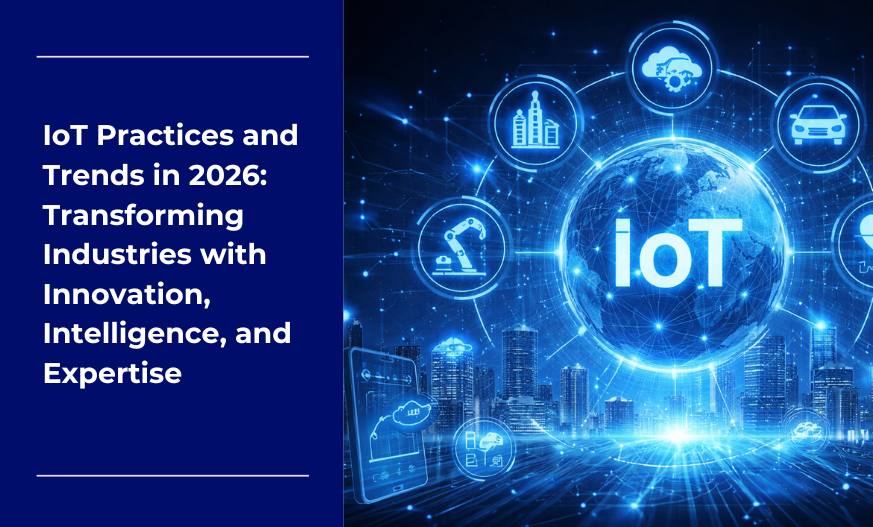
In 2026, the Internet of Things (IoT) has evolved from a promising digital concept into a foundational pillar of enterprise transformation. What once began as simple device connectivity has now matured into intelligent, autonomous ecosystems where machines, platforms, and analytics work in harmony to drive efficiency, resilience, and innovation.
Today’s IoT landscape is defined by real-time data intelligence, AI-driven decision-making, edge-first architectures, and secure cloud-native platforms. Organizations across manufacturing, healthcare, energy, smart cities, and research environments are leveraging IoT not only to automate operations but to gain predictive insights, optimize assets, and unlock new revenue models.
As businesses accelerate their digital transformation journeys in 2026, understanding IoT industry practices, standards, and emerging trends has become mission-critical. This blog explores the state of IoT in 2026, highlights the most impactful trends, addresses industry challenges, and demonstrates how BJIT’s IoT expertise empowers enterprises to succeed in an increasingly connected world.
Successful IoT implementations in 2026 are no longer experimental. They follow well-defined industry standards, architectures, and best practices that ensure scalability, security, and long-term value.
1. Interoperability and Open Standards
Modern IoT ecosystems rely on seamless interoperability between devices, platforms, and applications. Industry standards such as MQTT, CoAP, REST APIs, and OPC UA have become essential for enabling reliable communication across heterogeneous environments. Organizations are prioritizing vendor-agnostic architectures to avoid lock-in and ensure future scalability.
2. Security-by-Design and Zero Trust IoT
Cybersecurity remains the backbone of IoT adoption. In 2026, enterprises implement:
3. Edge Computing and Distributed Intelligence
To reduce latency and bandwidth costs, organizations deploy edge computing nodes that process data closer to devices. This enables real-time analytics, faster response times, and improved reliability for mission-critical systems.
4. AI and Data Governance Integration
IoT data in 2026 is governed by robust data lifecycle policies, ensuring quality, privacy, and compliance with regulations such as GDPR, HIPAA, and regional data protection laws. AI models are increasingly embedded into IoT platforms to automate insights and actions.
1. AI-Powered IoT (AIoT)
AIoT represents the convergence of artificial intelligence and IoT, enabling systems to analyze, learn, and act autonomously:
According to industry reports, over 65% of enterprise IoT deployments in 2026 integrate AI-based analytics, improving decision accuracy and operational efficiency.
2. Edge Computing Advancements
Edge computing has become a strategic priority due to:
Industries such as healthcare, smart manufacturing, and critical infrastructure increasingly deploy hybrid edge-cloud architectures to balance performance and scalability.
3. 5G and Next-Gen Connectivity
The global rollout of 5G and private wireless networks has unlocked ultra-low latency, massive device density, and high reliability.
Impact areas include:
By the end of 2026, 5G-enabled IoT connections account for a significant share of new industrial deployments worldwide.
4. Digital Twins and Predictive Analytics
Digital twins—virtual replicas of physical assets—are transforming how organizations simulate, monitor, and optimize operations.
Impact cases include:
Digital twins powered by real-time IoT data reduce downtime and enhance forecasting accuracy.
5. Sustainable and Energy-Efficient IoT
Sustainability is no longer optional. IoT solutions in 2026 prioritize:
Smart energy management systems powered by IoT contribute significantly to ESG goals and regulatory compliance.
Despite rapid technological advancements and growing enterprise adoption, IoT deployments in 2026 continue to face several critical challenges. These challenges span security, system integration, scalability, and organizational readiness, often determining the success or failure of large-scale IoT initiatives.
1. Security and Privacy Risks
IoT ecosystems significantly expand an organization’s attack surface by connecting thousands, and sometimes millions, of devices across networks and environments. Each connected device represents a potential entry point for cyber threats, making IoT systems particularly vulnerable to unauthorized access, data breaches, and malicious attacks.
In addition, IoT solutions often collect and process sensitive operational, personal, or research data. Ensuring data privacy across distributed devices, cloud platforms, and third-party integrations remains a major concern, especially in regulated industries where compliance requirements are strict and evolving.
2. Legacy System Integration
Many organizations operate within complex IT environments built on legacy systems that were not designed for real-time connectivity or data exchange. Integrating modern IoT platforms with these older systems can be technically challenging, time-consuming, and costly.
Differences in data formats, communication protocols, and system architectures often lead to interoperability issues, slowing down deployment timelines and limiting the full potential of IoT-driven transformation.
3. Scalability and Data Overload
As IoT deployments scale, the volume, velocity, and variety of data generated by connected devices increase exponentially. Managing this continuous stream of real-time data can strain network bandwidth, storage infrastructure, and analytics platforms.
Without careful planning, organizations may struggle to process, store, and derive meaningful insights from IoT data, leading to performance bottlenecks and reduced operational visibility.
4. Skills and Architecture Complexity
Designing and managing enterprise-grade IoT systems requires expertise across multiple domains, including hardware engineering, cloud architecture, cybersecurity, data analytics, and application development. The complexity of coordinating these components often exceeds the in-house capabilities of many organizations.
Additionally, the rapid evolution of IoT technologies makes it difficult for teams to keep pace with best practices, standards, and architectural patterns, increasing the risk of fragmented or inefficient implementations.
BJIT brings together deep technical expertise, strong domain knowledge, and proven execution excellence to help enterprises design, build, and scale robust IoT ecosystems. In 2026, successful IoT implementations require more than device connectivity—they demand secure cloud platforms, reliable hardware engineering, and intuitive data visualization, all working seamlessly together.
As illustrated in BJIT’s IoT expertise framework, BJIT delivers end-to-end IoT solutions across three critical layers—IoT Cloud & Server, Mechanical & Hardware Design, and Web & Dashboard Development—ensuring a holistic, scalable, and future-ready IoT architecture. This integrated approach enables organizations to move from concept to deployment with confidence, speed, and measurable business outcomes.
1. IoT Cloud & Server Expertise
At the core of every successful IoT system lies a secure, reliable, and scalable cloud infrastructure. BJIT specializes in building high-performance IoT backends that enable seamless device connectivity, real-time data streaming, and intelligent system orchestration.
Core Capabilities:
BJIT’s cloud expertise ensures low-latency communication, fault tolerance, and enterprise-grade security, making it ideal for mission-critical IoT environments.
Use Cases:
Through these implementations, BJIT enables organizations to handle large volumes of IoT data efficiently while maintaining reliability, scalability, and compliance with modern cybersecurity standards.
2. Mechanical & Hardware Design
IoT success depends not only on software but also on robust, well-engineered hardware that can operate reliably in real-world environments. BJIT’s mechanical and hardware design expertise ensures that IoT devices are built for durability, performance, and regulatory compliance.
Core Capabilities:
BJIT’s multidisciplinary engineering teams work closely across hardware and software domains to ensure seamless integration and optimized performance.
Use Cases:
By bridging hardware engineering with software intelligence, BJIT delivers IoT devices that are resilient, compliant, and ready for enterprise-scale deployment.
3. Web and Dashboard Development
Data is only valuable when it can be easily understood and acted upon. BJIT designs intuitive, user-centric IoT web dashboards that transform complex IoT data into clear, actionable insights for decision-makers.
Core Capabilities:
BJIT’s dashboards are built with scalability, usability, and performance in mind, enabling stakeholders to monitor operations, detect anomalies, and optimize processes in real time.
Use Cases:
These solutions empower businesses with operational transparency, faster response times, and data-driven control across their IoT ecosystems.
Organizations across industries trust BJIT as their IoT partner because of its end-to-end delivery capability and future-focused engineering mindset.
Key Differentiators:
By combining strategic insight with technical depth, BJIT helps enterprises reduce complexity, accelerate time-to-market, and maximize the business value of IoT investments.
Organizations adopting IoT with the right strategy and partner experience measurable benefits:
IoT has transitioned from an operational tool to a strategic business enabler.
IoT in 2026 represents a mature, intelligent, and deeply integrated technology ecosystem that continues to reshape industries worldwide. From AI-powered analytics and edge computing to secure cloud platforms and sustainable designs, the evolution of IoT is accelerating at an unprecedented pace. To fully realize its potential, organizations must stay aligned with industry standards, embrace emerging trends, and collaborate with experienced technology partners. BJIT’s comprehensive IoT expertise—spanning cloud, mechanical design, and web platforms—positions it as a trusted partner for enterprises navigating complex IoT journeys.
As IoT continues to evolve beyond 2026, innovation, security, and strategic execution will define the next generation of connected intelligence—and BJIT stands ready to lead that transformation.